

I visit many farms and meet many farmers throughout the year. Every visit teaches me something new. Whenever I walk through a field, I hear almost the same questions.
“Which fertilizer should I use?”
“How can I increase my yield?”
“Which product will give faster results?”
These are important questions, but one thing always makes me sad.
Very few people ask, “How is my soil?”
We spend hours talking about fertilizers, pesticides and production, but we rarely stop to think about the soil that makes all of these possible. We expect the soil to give us healthy crops every season, yet we forget to take care of it.
Imagine asking a person to work harder every day without giving them proper food or rest. After some time, they become weak. The same thing happens to our soil
Why Soil Health Matters
Soil is not just dirt. It is a living system filled with nutrients, microorganisms, water, and organic matter that help plants grow.
Healthy soil provides:
- Better crop growth
- Higher yields
- Improved water holding capacity
- Stronger plant roots
- Better nutrient availability
- Healthier food for consumers
When soil becomes unhealthy, crops become weak, production decreases, and farming costs increase.
The Challenges Farmers Face
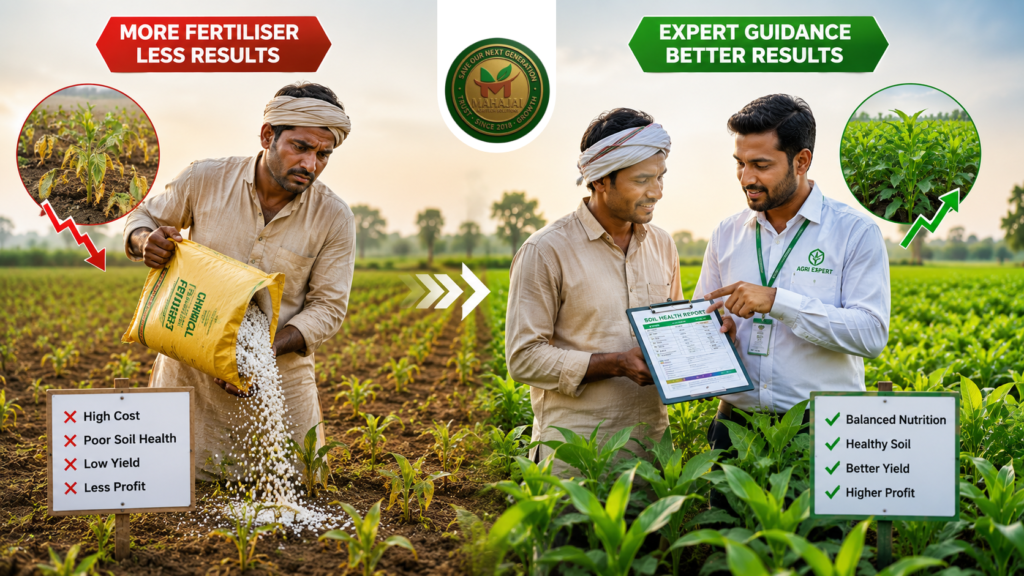
Many farmers have depended on chemical fertilizers for many years. While these fertilizers helped increase production in the beginning, excessive use has created several problems.
Some common issues include:
- Low organic carbon in soil
- Loss of important nutrients
- Reduced soil fertility
- Poor water retention
- Higher fertilizer requirements
- Increasing farming costs
- Lower farmer profits
As soil health declines, farmers often spend more money just to maintain the same crop yield.
A Practical Roadmap for Sustainable Agriculture
Improving soil health does not happen overnight, but small steps can make a big difference.
1. Improve Farming Practices
Farmers should adopt sustainable methods such as:
- Crop rotation
- Mixed cropping
- Reduced tillage
- Mulching
- Recycling crop residues
- Adding organic manure and compost
These practices improve soil structure and increase organic matter.
2. Use Balanced Nutrients
Instead of applying fertilizers without knowing the soil condition, farmers should use fertilizers according to soil test recommendations.
Balanced nutrition helps:
- Reduce unnecessary fertilizer use
- Save money
- Improve crop quality
- Maintain long-term soil fertility
3. Use Soil Health Cards
The Soil Health Card helps farmers understand the nutrient status of their fields. Based on the results, farmers can apply the right nutrients at the right time and in the right quantity.
4. Adopt Smart Agriculture
Modern technologies can make farming more efficient.
Examples include:
- Soil moisture sensors
- Precision farming
- AI-based crop advisories
- Drip irrigation
- Micro irrigation systems
These technologies help save water, fertilizer, and labour while increasing productivity.
5. Practice Regenerative Agriculture
Regenerative agriculture focuses on rebuilding soil naturally.
It includes:
- Compost application
- Farmyard manure
- Green manuring
- Mulching
- Natural bio-inputs
- Cover crops
These practices increase soil organic carbon, improve water retention, and support beneficial microorganisms.
Success Stories from Indian Farmers
Regenerative Coconut Farming – Tamil Nadu
A farmer in Tamil Nadu shifted to regenerative farming by using natural bio-inputs through a micro-irrigation system. He also grew different crops like banana, black pepper, and nutmeg between coconut trees.
The results were impressive:
- Higher soil organic matter
- Better coconut production
- Improved water retention
- Strong resistance during droughts and floods
This shows how healthy soil can make farms more climate-resilient.
Cotton Farmers in Maharashtra
Thousands of cotton farmers adopted regenerative farming methods.
They achieved:
- Higher crop yields
- Lower fertilizer and pesticide costs
- Better market prices for sustainable cotton
- Increased profits
Reducing input costs helped farmers earn more while protecting the environment.
Zero Budget Natural Farming – Andhra Pradesh
Many farmers shifted to Zero Budget Natural Farming by using natural homemade inputs instead of expensive chemicals.
The benefits included:
- Much lower farming costs
- Reduced dependence on chemical fertilizers
- Higher profits
- Healthier soil
This proves that sustainable farming can also be economically beneficial.
How MAHAJAI AGRITEC SOLUTIONS Supports Sustainable Farming
At MAHAJAI AGRITEC SOLUTIONS, we believe that healthy soil is the foundation of successful farming. Our products are developed to support soil health, improve nutrient availability and help farmers grow stronger, healthier crops.
Solutions such as Soil Recharge, Soil Gold Granules, Gold Root Tablet, Cow Manure (100% Natural & Organic) and our other soil nutrition products are designed to improve soil condition, encourage better root growth and make nutrients more available to plants. When used as part of good farming practices, they help improve soil productivity and support sustainable agriculture.
Our goal is not only to provide quality products but also to guide farmers with the right knowledge and practical solutions for long-term soil health.

Conclusion
Saving soil is not just about protecting the environment—it is about protecting farmers, our food, and future generations. Healthy soil produces healthy crops, reduces farming costs, improves farmer income, and supports sustainable agriculture.
Every small step matters. By adopting better farming practices, using modern technology, and improving soil health, we can build a future where both farmers and nature thrive together.