
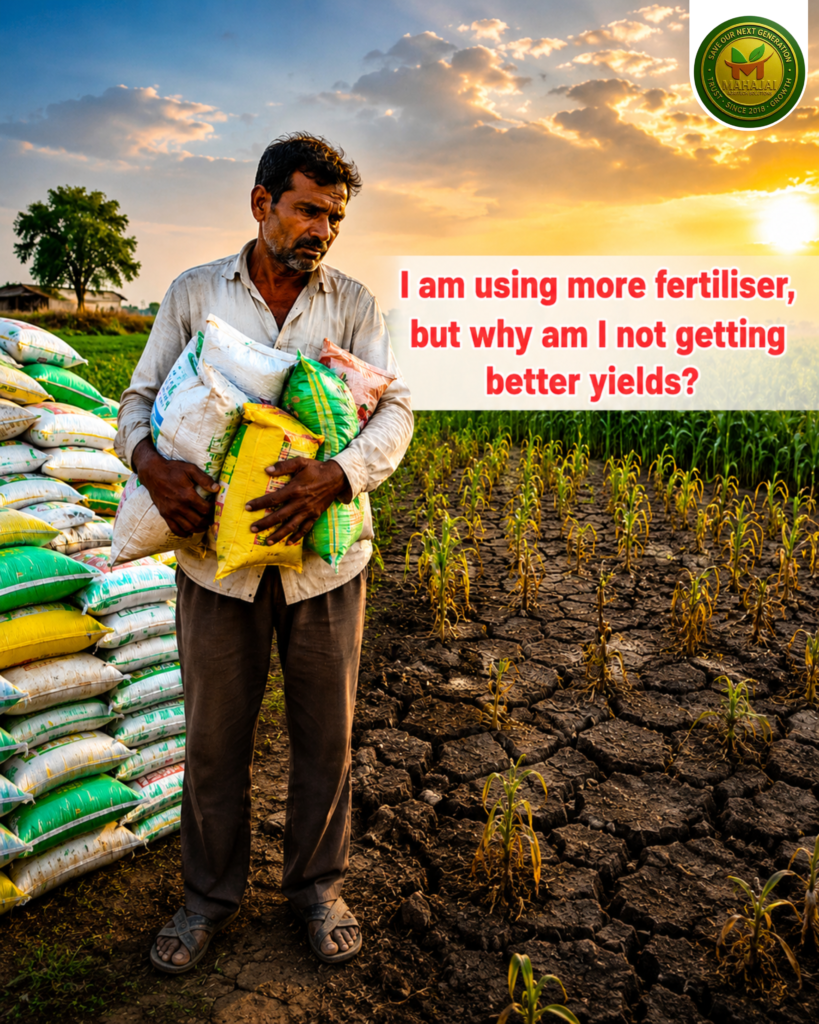
Have you ever felt that every year you are spending more money on fertilisers, but your crop production is not increasing the way it used to?
Many farmers across India are facing the same problem. Fertiliser costs are going up, but yields are either staying the same or increasing very little. This makes farmers wonder:
“Where is all the fertiliser going?”
The answer is not as simple as using more fertiliser. The real issue is that our soils are getting weaker, nutrient balance is getting disturbed, and crops are not able to use fertilisers efficiently.
Farming Has Changed
A few decades ago, one or two bags of fertiliser could make a big difference in crop production. Today, many farmers apply much more than before, but the results are not the same.
India uses huge quantities of fertilisers every year. But even after increasing fertiliser use, many farmers are not seeing the expected increase in yield.
This clearly shows that the problem is not only about quantity. It is also about efficiency.
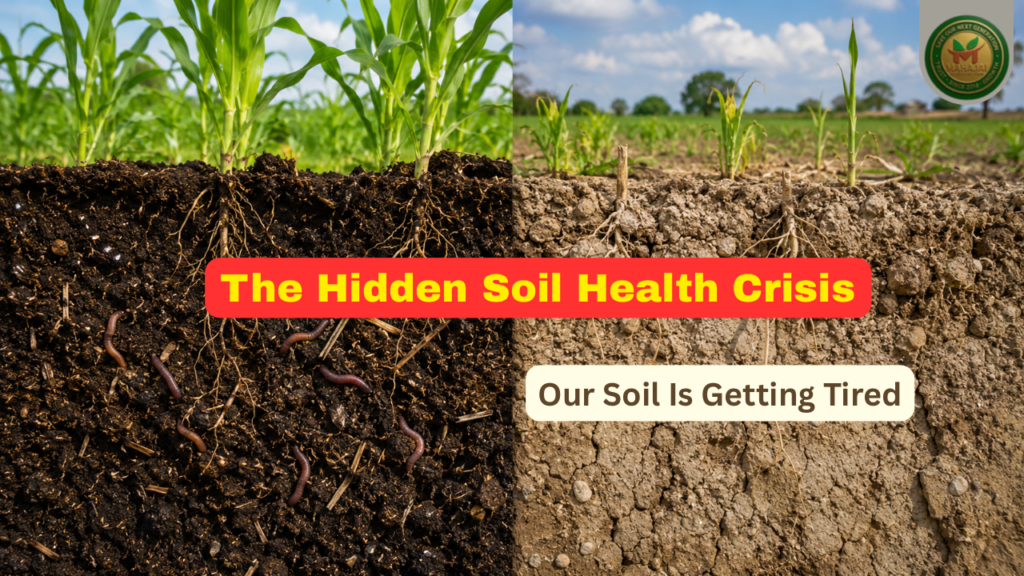
Our Soil Is Getting Tired
Think of soil as a living system.
Healthy soil contains organic matter, beneficial microbes, earthworms, and nutrients that help plants grow properly.
But after years of intensive farming, many soils have lost a large amount of their organic carbon and biological activity. Because of this, the soil cannot hold nutrients and moisture the way it used to.
When soil health declines, crops struggle to make full use of the fertilisers we apply.
As a result, farmers spend more but get less benefit.
Too Much Urea, Not Enough Balance
One of the biggest challenges in Indian farming today is the excessive use of nitrogen fertilisers like urea.
Nitrogen is important, but crops also need phosphorus, potassium, sulphur, zinc, boron, and many other nutrients.
When we repeatedly apply only nitrogen, the soil gradually becomes unbalanced.
The crop may look green for some time, but problems start appearing later in the form of poor flowering, weak fruit setting, lower quality produce, and reduced yield.
Balanced nutrition is becoming more important than ever.
Growing the Same Crop Again and Again
In many farming areas, the same crop is grown year after year.
Rice after rice.
Wheat after wheat.
Cotton after cotton.
This practice removes the same nutrients from the soil repeatedly.
Over time, the soil becomes deficient in important nutrients, forcing farmers to use more fertilisers just to maintain production.
Crop rotation and diversification can help reduce this pressure and improve soil health.
Are Crops Using All the Fertiliser We Apply?
The surprising answer is No.
Research shows that a large portion of fertiliser applied in the field is not actually absorbed by the crop.
Some nutrients are washed away with water. Some are lost into the atmosphere. Some remain locked in the soil.
This means farmers are often paying for nutrients that never reach the plant.
That is why improving nutrient use efficiency is becoming a major focus in modern agriculture.
Soil Testing Can Save Money
Many fertiliser decisions are still based on experience or guesswork.
But every field is different.
A soil test can tell us exactly what nutrients are needed and what nutrients are already present in the soil.
Instead of applying extra fertiliser, farmers can apply the right fertiliser at the right time and in the right quantity.
This not only saves money but also improves crop performance.
The Future Is Smarter Farming
The future of farming is not about using more fertiliser.
It is about using fertilisers more efficiently.
Today, farmers are slowly adopting better practices such as:
- Balanced crop nutrition
- Soil health management
- Organic carbon improvement
- Bio-stimulants
- Nano fertilisers
- Precision farming technologies
These methods help crops use nutrients more effectively while reducing unnecessary input costs.

Mahajai Agritech Solutions – Our Mission
At Mahajai Agritech Solutions, we believe that healthy soil is the foundation of successful farming.
Our mission is to help farmers improve crop productivity while maintaining long-term soil health.
We focus on solutions that support every stage of crop growth.
For soil health and carbon improvement, we offer products like Soil Recharge and Kisan gold granules.
For strong root development and vegetative growth, farmers can benefit from Gold Root Tablet and Champion.
For better flowering and fruit setting, we provide Flower King and many more for fruit development, yield improvement, and quality enhancement, helps improve size, weight, colour, and overall crop quality.
And to improve spray performance, Run-80 helps nutrients and crop protection products spread and work more effectively.
Our goal is simple:
Help farmers get better results from every rupee they invest in farming.
Conclusion
The challenge in Indian agriculture today is not the shortage of fertilisers.
The real challenge is declining fertiliser efficiency and poor soil health.
Using more fertiliser every year is not a long-term solution.
Healthy soil, balanced nutrition, efficient nutrient management, and modern farming practices are the keys to sustainable farming.
Because at the end of the day, successful farming is not just about feeding the crop.
It is about taking care of the soil that feeds the crop.